If your child is about to start nursery or Reception, you have probably come across the letters EYFS. But what does it actually mean, and why should you care? This article explains the Early Years Foundation Stage framework in plain English, what it means for your child’s learning, and what to look for when choosing a nursery that brings it to life well.
What Is the EYFS?
The Early Years Foundation Stage – often shortened to EYFS – is the statutory framework that governs the care, learning, and development of all children from birth to five years old in England. Every registered nursery, childminder, and Reception class must follow it by law.
The framework was designed to ensure that every young child, regardless of background or starting point, has access to high-quality early education and care during the most critical years of their development. It sets out what children should be learning, how practitioners should support that learning, and the standards that settings must meet to keep children safe and healthy.
The EYFS was most recently updated in 2021, with a stronger emphasis on communication and language, and a clearer focus on the skills children need before they move into formal schooling.
The Seven Areas of Learning
The EYFS organises children’s development into seven areas of learning, split into prime areas and specific areas.
The Three Prime Areas
These are considered the foundation for everything else, and they are the focus of the earliest years:
- Communication and Language – listening, attention, understanding, and speaking
- Physical Development – movement, balance, coordination, and healthy habits
- Personal, Social and Emotional Development – self-confidence, managing feelings, building relationships
The Four Specific Areas
These build on the prime areas as children grow:
- Literacy – reading and writing readiness
- Mathematics – number, shape, space, and measure
- Understanding the World – exploring their environment, people, communities, and technology
- Expressive Arts and Design – creativity through art, music, movement, and imaginative play
Good nurseries do not deliver these areas as separate lessons. Instead, they weave them together through thoughtfully planned play, daily routines, and child-led exploration.
The Characteristics of Effective Learning
Alongside the areas of learning, the EYFS describes three Characteristics of Effective Learning – the ways in which children best learn and develop:
- Playing and Exploring – finding out about things, trying experiences out, being willing to have a go
- Active Learning – staying focused, persisting when challenges arise, enjoying achieving
- Creating and Thinking Critically – having their own ideas, making links between ideas, developing strategies
These characteristics underpin everything. A child who is curious, persistent, and creative is far better prepared for school and life than one who has simply been taught to sit still and repeat information. Good nurseries nurture these qualities every single day.
What the EYFS Means for Your Child Day to Day
In practice, the EYFS shapes almost everything that happens in a nursery. The way rooms are set up, the activities on offer, the way staff talk to children, the books they read, the outdoor time they have, the meals they eat – all of it can be connected back to the framework.
But here is the important thing: the EYFS is not a rigid curriculum. It does not dictate that every two-year-old must be doing a specific activity on a specific day. It is a framework that good practitioners use to make thoughtful decisions about what each individual child needs next.
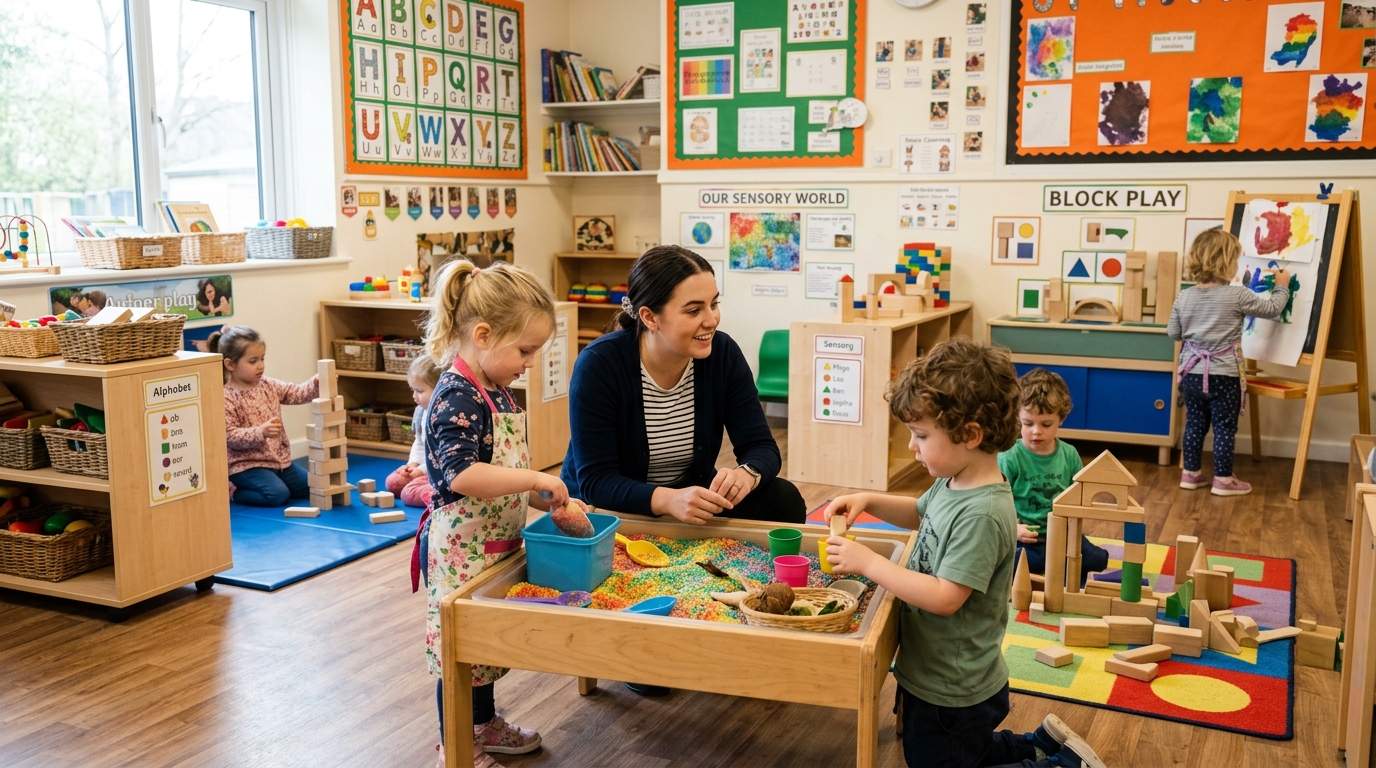
When you visit a nursery, you might see a child playing in the sandpit and think they are just playing. A skilled early years practitioner, however, is watching for language development, physical coordination, problem-solving, and social interaction – all EYFS areas, happening simultaneously through play.
The Role of Observation and Assessment
Nurseries are required to observe and assess children’s progress as part of the EYFS. This is not about formal tests or sitting children down with worksheets. It means practitioners watching, listening, and noting what children can do, what interests them, and what they might need support with next.
At two years old, all children are entitled to a progress check that gives parents a summary of their development in the three prime areas. At the end of the Reception year, children are assessed against the EYFS Profile.
Ask any nursery you are considering how they record observations and share them with parents. Good settings will show you examples and explain how they use what they observe to plan next steps for each child.
What to Look for in a Nursery’s EYFS Practice
All nurseries must follow the EYFS – but the quality with which they do it varies enormously. Here are the signs of a setting that is genuinely good at bringing the framework to life:
- Staff who can talk fluently about what they are trying to support for each child, not just describe the activity
- A rich indoor and outdoor environment that invites exploration and discovery
- A mix of adult-led and child-initiated activities, with children given genuine agency over their play
- A focus on communication and language throughout the day, including lots of conversation, stories, and singing
- Regular, meaningful updates shared with parents about their child’s progress
- A culture of warmth and positive relationships between staff and children
EYFS and School Readiness
One question parents often ask is whether following the EYFS means their child will be ready for school. The answer is yes – but perhaps not in the way you might expect.
School readiness is not about knowing your numbers to twenty or being able to write your name before Reception. It is about being curious, able to listen, willing to try new things, able to manage some frustration, and capable of building relationships with adults and other children. These are the qualities the EYFS is designed to nurture.
A child who has had a high-quality early years experience is not just prepared for school – they are prepared for learning, which is a rather bigger and more important thing.
How We Bring the EYFS to Life at Dee’s
At Dee’s Day Nursery in Wimbledon, the EYFS is not a compliance exercise – it is the foundation of everything we do. Our four pillars of well-being, exploration, communication, and environment map directly onto the framework’s priorities, and our team plans carefully around each child’s individual needs and interests.
We are based in Wimbledon SW19 4AA, seven minutes’ walk from Wimbledon station, and we care for children from six months to five years old across our Babies, Toddlers, and Preschool rooms. Our team shares regular updates with parents through the Famly app, including observations, photos, and notes on your child’s learning and development.
Would you like to see the EYFS in action? Come and visit us. Book a tour at www.deesnursery.co.uk and we will show you how we bring early years learning to life every day.