As children approach their fourth and fifth birthdays, the conversation around nursery often shifts to one topic: is my child ready for school? But school readiness nursery provision is widely misunderstood. School readiness is not about whether a child can count to twenty or recognise the letters of their name. It is something much broader — and much more interesting — than that. This post explains what school readiness actually means, how good nursery provision builds it, and what parents can do to support the process at home.
What School Readiness Actually Means
The term “school readiness” has suffered from narrowing in recent years. In some conversations, it gets reduced to academic skills — letters, numbers, phonics. But teachers and early years specialists are largely agreed that this misses the point. A child can know their alphabet and still not be ready for Reception. Equally, a child who cannot yet write their name may be perfectly equipped to thrive in a school environment.
True school readiness encompasses several interconnected areas:
Emotional and Social Readiness
Can your child separate from you without prolonged distress? Can they manage mild frustration without becoming overwhelmed? Can they take turns, share, and navigate disagreements with peers? These emotional and social skills are among the most reliable predictors of a positive transition to school. A child who enters Reception already able to regulate their emotions and relate to others is in a strong position, regardless of their academic knowledge.
Communication and Language
Can your child make themselves understood by adults who do not know them well? Can they follow multi-step instructions? Do they ask questions, tell stories, and express their feelings in words? Strong communication and language skills underpin all academic learning — a child who struggles to understand or communicate will find every lesson harder, not just English.
Physical Development
Physical readiness is often overlooked in school readiness conversations. Can your child manage their own coat and shoes? Can they use a pencil with some control? Can they sit still for a short period when needed? These gross and fine motor skills develop through play, outdoor activity, and hands-on experience — they cannot be rushed through direct teaching.
Independence and Self-Care
Can your child use the toilet independently? Can they manage their own lunchbox and water bottle? Can they ask for help when they need it? Reception teachers often report that children who struggle in the early weeks are not those with the least academic knowledge — they are those who are least independent in their self-care.
Curiosity and Love of Learning
Perhaps most importantly: does your child approach new experiences with curiosity and confidence? A child who is used to exploring, discovering, and problem-solving through play will bring these same dispositions to the classroom. Curiosity is teachable — but it is taught through rich, varied, child-led play experiences, not through rote learning.
How the Preschool Room Prepares Children for Reception
The preschool room in a good nursery setting is specifically designed to bridge early childhood and the start of formal education — without forcing children to grow up before they are ready. The approach remains play-based (as required by the EYFS), but the activities, expectations, and opportunities are calibrated to the developmental stage of three- to five-year-olds.
In a well-run preschool room, you should expect to see:
- Opportunities to practise writing and mark-making in purposeful contexts (writing a shopping list in the role-play area, making a sign for a den)
- Mathematical thinking embedded in play (sorting, counting, measuring, patterns)
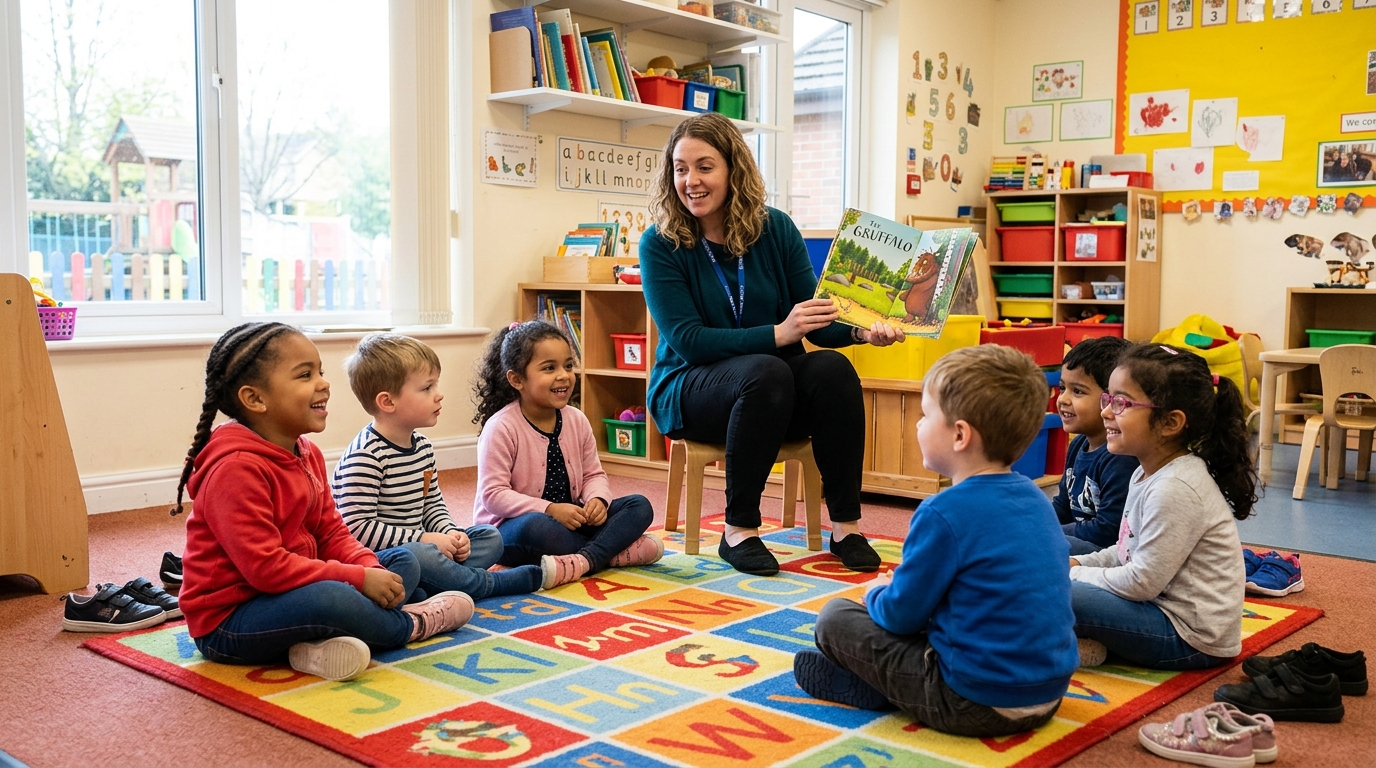
- Regular story time, rhymes, and conversations that build language and literacy
- Projects and topics that encourage sustained interest and investigation over time
- Increasing independence in self-care and decision-making
- Opportunities to work both in groups and individually
- A gradual introduction to the kind of sitting, listening, and group activities that Reception will involve
Good preschool provision does not push children into formal learning before they are developmentally ready. It prepares them for the transition by ensuring they are confident, curious, and emotionally regulated — which is the foundation on which all school learning is built.
What Parents Can Do at Home to Support School Readiness
School readiness is not only built in the nursery. Parents play a central role, and the good news is that most of what helps is enjoyable and does not require flashcards or structured lessons.
- Read together daily. Sharing books builds vocabulary, comprehension, and a love of stories. It does not matter whether you read picture books, information books, or a mix — variety is good.
- Talk about everything. Describe what you are doing, ask open questions, and listen to your child’s answers. Conversations build language more effectively than any educational toy.
- Let them be independent. Encourage your child to dress themselves, pour their own drink, and manage small tasks. Resist the urge to do things for them when they are capable.
- Play freely and imaginatively. Role play, construction, drawing, and outdoor play all build the cognitive and social skills school needs. Unstructured play is not wasted time.
- Practise separation positively. If your child is anxious about transitions, practise short separations and model calm confidence at goodbyes.
- Talk about school positively and matter-of-factly. Children take cues from their parents. If you are anxious about the transition, they will be too. Neutral, warm language about school going to be an exciting new adventure sets the right tone.
What to Look for in a Nursery’s Preschool Provision
If you are choosing a nursery with school readiness in mind, here are questions worth asking about the preschool room specifically:
- How do you approach the transition to school? Do you have links with local Reception classes?
- How do you balance child-led play with more structured activities for older children?
- How do you support children who may be finding the transition emotionally difficult?
- How do you communicate with parents about their child’s readiness for school?
- What does a typical day look like in the preschool room?
- How do you support children with additional needs or developmental delays?
School Readiness at Dee’s Day Nursery, Wimbledon
At Dee’s Day Nursery on Hartfield Road in Wimbledon, school readiness is understood in the fullest sense of the term. The preschool room provision is guided by the EYFS and by the nursery’s four development pillars: Well-being, Exploration, Communication, and Environment. These four pillars correspond closely to the broadest definition of school readiness — a child who is well, curious, communicative, and confident in their environment is a child who is ready for the next step.
The nursery’s approach is play-based but purposeful. Older children in the preschool room are given increasing responsibility, independence, and challenge as they move towards school age. The key person approach means that each child’s readiness is understood individually — no two children are the same, and the nursery does not treat them as if they are.
Dee’s is open Monday to Friday, 8am to 6pm, for children from six months to five years. It is a seven-minute walk from Wimbledon station.
Book a Tour and See the Preschool Room
If your child is approaching school age and you want to see how Dee’s prepares children for Reception, come and visit us. Seeing the preschool room in action and talking to the team will give you a clear sense of how school readiness is built, day by day, through meaningful play and warm relationships.
Visit www.deesnursery.co.uk to find out more and to book a tour. We would love to meet you and your family.