Ask any early years practitioner what one of the most valuable parts of a nursery day is, and many will say the same thing: time outside. The evidence behind outdoor play young children is substantial and spans multiple areas of development. Yet outdoor time is still sometimes treated as a bonus — something that happens when the weather is nice and the schedule allows. Good nurseries know better. Outdoor play is not a break from learning. It is learning.
Why Outdoor Play Matters for Young Children’s Development
The developmental benefits of outdoor play are wide-ranging and well documented. Here is what regular, meaningful time outside offers children in the early years:
Physical Development and Gross Motor Skills
Outdoor environments give children the space to move in ways that indoor rooms simply cannot accommodate. Running, jumping, climbing, balancing, digging, rolling, and throwing all develop gross motor skills — the large muscle movements that underpin physical confidence and coordination. These skills are not just about fitness; they feed directly into the fine motor control children need for drawing, writing, and self-care tasks.
Outdoor play also supports proprioception (the sense of where your body is in space) and vestibular development (the sense of balance and movement). Activities like spinning, swinging, rolling down a slope, and climbing are not random — they are precisely what young bodies need to develop a secure physical sense of self.
Cognitive Development and Scientific Thinking
The outdoor world is a natural laboratory. Children who spend time in gardens, on grass, and around plants and animals are constantly observing, questioning, and experimenting. They notice that puddles appear after rain and disappear in the sun. They see that seeds grow into plants. They learn that some surfaces are slippery, that wind can move objects, that worms live in soil.
This kind of direct, hands-on enquiry builds the foundations of scientific thinking — observation, prediction, testing, and conclusion. It also stimulates curiosity, which is one of the most important dispositions a child can develop. A child who asks questions is a child who is ready to learn.
Risk-Taking and Resilience
Managed risk in outdoor play is genuinely beneficial. When children climb a little higher than is completely comfortable, or navigate uneven ground, or try something they are not sure they can do, they learn something crucial: that challenge is manageable, that mistakes are survivable, and that persistence pays off.
The trend toward overly sanitised, perfectly safe play environments has been criticised by researchers and practitioners precisely because it removes these opportunities. Children need to encounter and overcome small challenges in order to develop resilience and self-belief. A good outdoor space gives them the chance to do this within appropriate boundaries.
Emotional Wellbeing and Mental Health
Time outdoors — particularly in natural environments — has consistently been shown to reduce stress and improve mood in children and adults alike. Natural light supports healthy sleep patterns and circadian rhythms. Fresh air and physical movement release tension. The relative freedom of outdoor space allows children to decompress and regulate their emotions in ways that a busy indoor environment may not permit.
For children who find nursery overwhelming, particularly in the settling-in period, outdoor time can be an important pressure-release valve. The sensory experience of fresh air, open space, and natural textures can be calming in a way that no amount of soft furnishings indoors can replicate.
What a Good Outdoor Environment Looks Like
Not all outdoor spaces are created equal. A patch of tarmac with a few fixed pieces of plastic equipment is a very different thing from a thoughtfully designed outdoor learning environment. When visiting a nursery, the outdoor area is worth looking at carefully.
Signs of a good outdoor environment include:
- A mix of surfaces — grass, sand, bark, hard surfaces — that offer different sensory and physical experiences
- Space to run and move freely, as well as quieter corners for smaller-scale play
- Natural elements: plants, water, soil, loose parts like sticks, stones, and pine cones
- Age-appropriate equipment that offers genuine challenge as well as accessible activities
- Resources that encourage creativity — den-making materials, art supplies, construction tools
- Opportunities for growing things: raised beds, window boxes, or garden areas
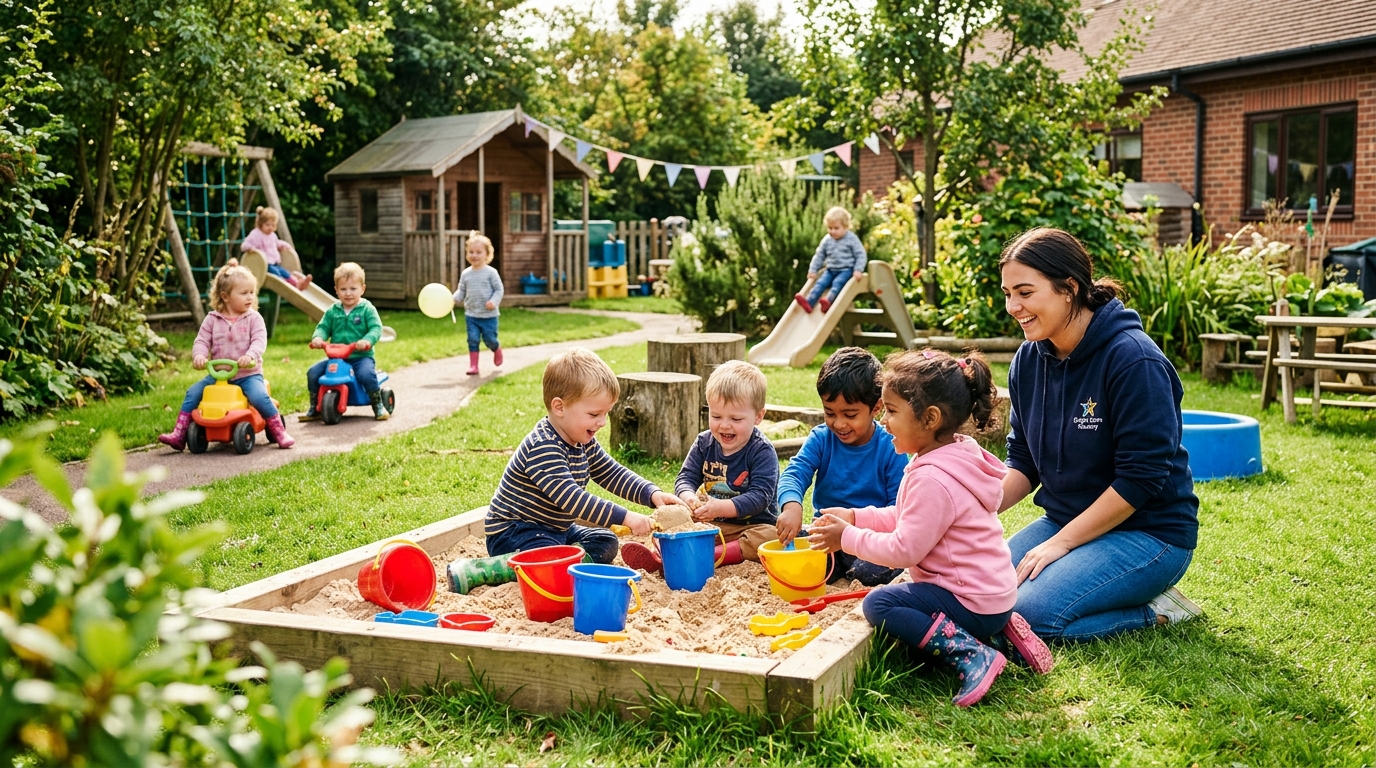
At Dee’s Day Nursery in Wimbledon, the spacious garden is a central part of daily life. Children across all age groups — from the baby room to the preschool room — have access to the outdoor space as part of their regular day, not just as an occasional treat.
Outdoor Play in All Weathers: Why Weather Should Not Stop It
One of the most common concerns parents raise about outdoor time is the British weather. And it is a fair point — there is a lot of it. But the evidence suggests strongly that outdoor play should continue in most weather conditions, with appropriate clothing.
Rainy days bring puddles, mud, running water, and the sensory experience of rain itself. Windy days are perfect for experimenting with movement, kites, and the physics of falling leaves. Cold days offer opportunities to notice frost, breath clouds, and the changing appearance of familiar spaces. Each season brings its own learning opportunities.
The phrase “there is no bad weather, only inappropriate clothing” has become something of a cliche in early years settings — but it reflects something real. Children who are warmly dressed and enthusiastically led by staff who genuinely enjoy being outside will engage fully regardless of the weather. It is the attitude of the adults that makes the biggest difference.
Ask any nursery how they approach outdoor play in winter or rain. A nursery that hedges or says they “try to get outside when they can” is telling you something different from one that says outdoor time happens every day, come rain or shine.
The Role of Outdoor Play Within the EYFS
The Early Years Foundation Stage framework recognises outdoor play as a key component of provision. It is not presented as separate from indoor learning — it is integral to it. The seven areas of learning and development can all be supported and extended outdoors: physical development, communication and language, personal, social and emotional development, understanding the world, mathematics, literacy, and expressive arts and design.
A nursery that limits outdoor access is, in effect, limiting the curriculum it can offer. A nursery that uses the outdoor environment creatively is giving children access to richer, more varied learning experiences.
How Dee’s Day Nursery Uses Its Garden
Dee’s Day Nursery is situated on Hartfield Road in Wimbledon and benefits from a spacious garden that is used across all rooms and age groups. The garden supports the nursery’s four development pillars — Well-being, Exploration, Communication, and Environment — in direct and practical ways.
Children in all rooms have daily outdoor sessions, and the garden is set up to encourage child-led exploration alongside guided activities. Whether it is digging in the soil, observing what lives under stones, building with natural loose parts, or simply running and climbing, the garden at Dee’s is designed to foster curiosity and physical confidence in equal measure.
The nursery’s tagline — “Fostering curiosity and development” — is perhaps most visibly evident outdoors. It is in the garden that children ask the best questions, take on the most satisfying challenges, and do some of their most absorbed, purposeful play.
Visit Dee’s and See the Garden for Yourself
If outdoor play is a priority for your family — and we think it should be — then seeing the outdoor space in person is essential. A photograph can only tell you so much about how a garden feels, how it is used, and what the atmosphere is like when children are out there.
We warmly invite you to book a tour of Dee’s Day Nursery in Wimbledon and see our garden and outdoor provision for yourself. Visit www.deesnursery.co.uk to find out more and to arrange a visit. We would love to meet you.