When parents think about what matters at nursery, mealtimes often come fairly low on the list — somewhere below staffing ratios, outdoor space, and the key person approach. But nursery meals early childhood provision is more significant than many parents realise. What children eat, how they eat it, and who they eat it with shapes far more than just their nutritional intake. Mealtimes in early childhood are a rich site of development — social, emotional, physical, and relational. This post explains why, and what to look for when choosing a nursery.
Mealtimes Are About More Than Food
The most obvious function of nursery meals is nutritional — children need energy and nourishment to grow and learn, and a well-fed child is in a better position to engage with the day. But reducing mealtimes to their nutritional function misses most of what is actually going on.
Social Learning at the Table
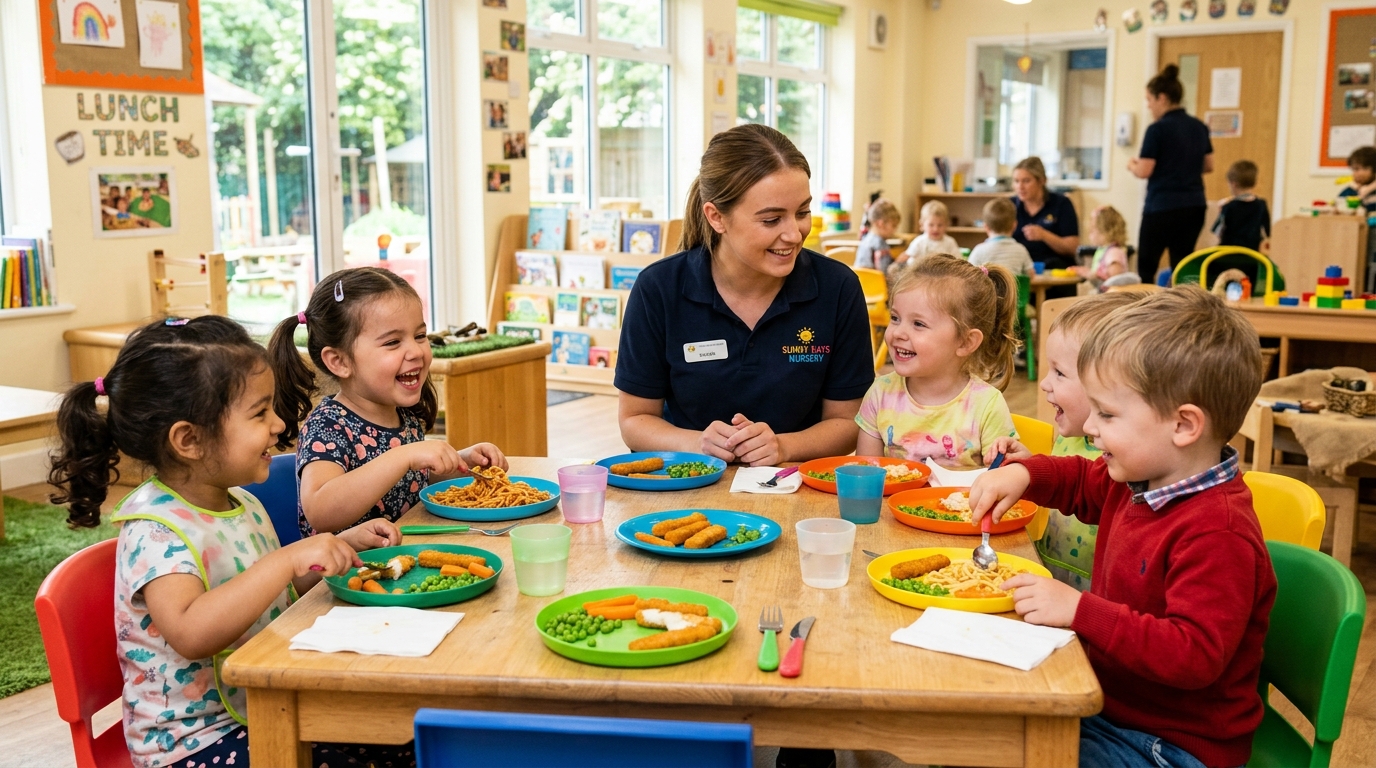
For young children, eating together is a significant social experience. Sitting at a table with peers and adults, passing food, waiting for others, making conversation, noticing what others are eating — all of these are social skills being practised in real time. Children who eat communally in early childhood develop a more sophisticated set of social behaviours around food than those who eat alone or in front of screens.
Shared mealtimes also provide a natural context for language development. The relaxed, purposeful nature of a meal table — where there is something to talk about, point at, and respond to — generates conversation. Adults who eat with children model vocabulary (naming foods, describing tastes and textures), turn-taking, and the kind of back-and-forth exchange that builds communication skills.
Routine and Emotional Regulation
Young children benefit enormously from predictable daily routines, and mealtimes are among the most regular and reliable anchors in a nursery day. Knowing that lunch happens after outdoor play, that there is a snack mid-morning, that the table is set in a certain way — this predictability is genuinely calming for children who may find other parts of the day more uncertain.
For children who struggle with transitions or who find the busy pace of nursery overwhelming, mealtimes can be a moment of relative calm and regularity. The ritual of sitting down together, the familiar smells and textures of food, and the social warmth of the table can all function as emotional regulating experiences.
Building a Healthy Relationship with Food
Early childhood is a critical period for forming attitudes and habits around food. Children who are consistently offered a varied, balanced diet in a relaxed and positive social context are more likely to develop broad food preferences and a healthy relationship with eating. Children who experience pressure around food — being urged to finish their plate, having food used as reward or punishment, or being told off for not trying something — are more likely to develop anxiety, fussiness, or avoidance around mealtimes.
A nursery that approaches mealtimes with care — offering variety without pressure, responding calmly to refusals, modelling enjoyment of food — is contributing to something with long-term significance. The habits and attitudes formed in early childhood around eating are often remarkably persistent.
What to Look for in Nursery Food Provision
When evaluating a nursery’s mealtime provision, here is what is worth looking at and asking about:
Quality and Variety of Food
Ask to see a sample menu. Good nursery food should be varied, nutritionally balanced, and genuinely prepared from fresh ingredients where possible. Be cautious of menus that rely heavily on processed foods, or that cycle through the same limited range of meals.
Ask whether the nursery has a cook or chef on site, or whether meals are prepared off site and delivered. On-site food preparation generally means fresher food and more flexibility to respond to individual needs. It also means the kitchen team can be part of the nursery community — children may have opportunities to learn about food preparation, see and smell what is being cooked, or grow ingredients in the garden.
Allergy and Dietary Management
This is non-negotiable. Ask explicitly how the nursery manages food allergies and intolerances. There should be clear written procedures for every child with a dietary requirement. Ask who is responsible for checking labels, who approves substitutions, and how staff are trained. A nursery that is vague or casual about allergy management is one to approach with real caution.
Ask also how they handle common dietary preferences — halal or kosher requirements, vegetarian or vegan families, or families with strong preferences about particular ingredients. A well-run nursery will have straightforward, respectful processes for all of these.
The Mealtime Atmosphere
If you visit at a mealtime, watch the atmosphere. Are children sitting together? Is there conversation? Are staff eating with children, or supervising from a distance? Is the pace relaxed, or are children being hurried through?
Good mealtime practice looks like: children and adults sitting together, food served family-style where possible (so children can help themselves), calm and pleasant conversation, and a genuine absence of pressure around eating. Children who are not hungry or who do not want to try something should be able to decline without drama.
Age-Appropriate Provision
Mealtime needs vary enormously across the age range of nursery children. Babies starting weaning need very different provision from toddlers exploring a full range of textures, and preschool children need something different again. Ask how the nursery tailors its food provision to different age groups and development stages.
How Dee’s Day Nursery Approaches Mealtimes
At Dee’s Day Nursery on Hartfield Road in Wimbledon, meals are prepared fresh on site by the nursery’s own chef. The menu is varied and balanced, with attention to nutritional quality and age-appropriate portions. The approach to mealtimes reflects the nursery’s broader values — mealtimes are communal, relaxed, and treated as a meaningful part of the day rather than a logistical interruption to it.
The nursery takes dietary requirements and allergies seriously. Families are asked for full information on enrolment, and individual requirements are recorded, communicated to kitchen staff, and reviewed regularly. The team at Dee’s understands that for some families, food safety is a matter of real health significance, and this is treated accordingly.
The four development pillars that guide daily life at Dee’s — Well-being, Exploration, Communication, and Environment — are all active at the mealtime table. Sharing food builds community (Environment and Communication), exploring new tastes and textures supports curiosity (Exploration), and the relaxed social pace of mealtimes contributes directly to emotional Well-being.
Questions to Ask About Nursery Meals When Visiting
- Are meals prepared on site, and can I see a sample menu?
- How do you handle food allergies and intolerances?
- How do you approach mealtimes with children who are fussy eaters or who refuse food?
- Do staff eat with children at mealtimes?
- How do mealtimes differ across age groups — babies, toddlers, preschoolers?
- How are snacks managed during the day?
- Can I see the kitchen and meet the cook?
Mealtimes as a Window into Nursery Culture
Here is something worth remembering when you visit a nursery: mealtimes are a reliable window into the broader culture of the setting. A nursery where mealtimes are warm, social, unhurried, and pleasurable for children is almost certainly one where the same values apply to the rest of the day. A nursery where children are rushed, where food is merely functional, and where staff are absent from the table tells you something too.
It is worth, if you can, timing a nursery visit to include a snack or mealtime. What you see will tell you a great deal.
Find Out More and Book a Tour
If nursery meals and mealtime culture matter to your family — and we think they should — we would love to show you around Dee’s Day Nursery and introduce you to our chef and kitchen. Seeing how we approach food and mealtimes is a much more informative experience than reading about it.
Dee’s Day Nursery is on Hartfield Road in Wimbledon, seven minutes’ walk from Wimbledon station, and is open Monday to Friday, 8am to 6pm, for children aged six months to five years.
Visit www.deesnursery.co.uk to find out more and to book a tour. We look forward to meeting you.