Young children thrive on predictability. If you have ever noticed that your toddler becomes unsettled after a disrupted day, or that your baby is easier to feed and settle when you follow a consistent pattern, you have already seen this in action. Routine is not just a practical convenience for parents and nurseries. It is a genuine developmental support for young children.
This post looks at why daily routine matters so much in early childhood, what the key elements of a well-structured nursery day look like, and how the team at Dee’s Day Nursery in Wimbledon approaches the rhythm of each day across the different age groups.
Why Routine Matters for Young Children
The first five years of life are a period of rapid brain development. During this time, children are building the neural pathways that will support their ability to think, feel, and behave throughout their lives. Predictable routines play a direct role in this process.
When a child knows what to expect, their stress response is lower. They do not have to spend energy anticipating what comes next or managing uncertainty. That freed-up energy can go into learning, playing, exploring, and building relationships. A child who feels secure in their environment is far better placed to engage with the world around them.
Routine also supports the development of self-regulation. When children experience the same sequence of events repeatedly, for example, lunch followed by quiet time followed by outdoor play, they begin to anticipate transitions and manage them more smoothly. This is an early form of emotional regulation, and it is a skill that matters enormously as children grow.
The Key Elements of a Well-Structured Nursery Day
Not all nursery days are structured the same way, and the right rhythm will vary depending on the age group. But there are some consistent elements that a thoughtful nursery day should include.
A calm, consistent arrival
How the day starts matters. A predictable arrival routine, greeting from the key person, bag away, find an activity, helps children transition from home to nursery without unnecessary stress. For younger children especially, this handover moment needs to be warm and consistent.
Mealtimes at regular intervals
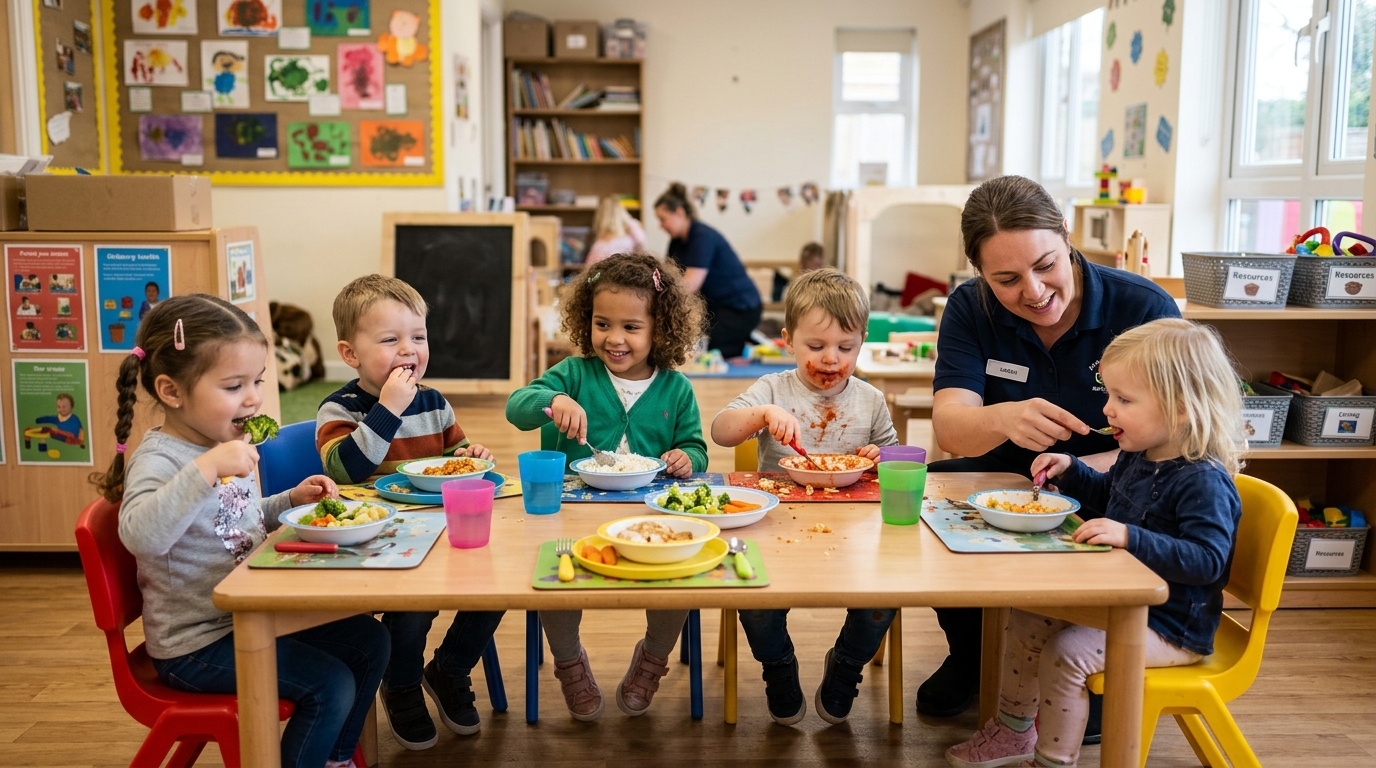
Young children have small stomachs and high energy needs. Regular snacks and mealtimes keep blood sugar stable, which directly affects mood, concentration, and behaviour. Mealtimes are also social occasions: sitting together, waiting for others, passing food, and talking about the day are all rich developmental opportunities.
Sleep and rest
Babies and younger toddlers need sleep during the nursery day, and this should be accommodated individually rather than on a fixed whole-room schedule. Preschool-age children may not need to sleep, but quiet time, whether that is reading, puzzles, or calm creative play, is still valuable for emotional regulation.
Outdoor time, every day
Access to outdoor space is not a treat or a weather-dependent bonus. It is a daily essential. Physical movement, fresh air, nature, and the different sensory experience of being outside all contribute to children’s health, development, and wellbeing. Children who spend time outdoors regularly sleep better, are calmer, and develop stronger gross motor skills.
Free play and child-led activity
Within a structured day, there must be time for children to direct their own play. Free play is how children make sense of the world, practise skills, and develop imagination and creativity. A day that is entirely adult-led, however well-intentioned, does not give children the space they need to explore and learn independently.
Group activities and circle time
Coming together as a group, for a story, a song, a short discussion, or a shared activity, supports language development, social skills, and a sense of belonging. These moments do not need to be long or formal. Even ten minutes of circle time with a nursery rhyme and some conversation has real developmental value.
How Routine Supports Language and Social Development
One of the less obvious benefits of routine is how much it supports language development. When the same words are used in the same context day after day, children quickly begin to understand and then use them. “Time to wash our hands” before lunch. “Shoes on, we’re going outside.” “Story time, let’s choose a book.” These repeated phrases become anchors that children can predict, respond to, and eventually use themselves.
Routine also creates the conditions for social development. When children eat together, tidy up together, and move through the day together, they are learning to wait their turn, share space, notice others’ needs, and work as part of a group. These are not incidental skills. They are among the most important things a child learns before they start school.
What Happens When Routine Breaks Down
Anyone who has been through a holiday, an illness, or a house move with a young child will know what happens when routine goes out of the window. Behaviour can become challenging, sleep often suffers, and children can seem unsettled without being able to articulate why.
This is not naughtiness. It is a predictable response to unpredictability. Children’s nervous systems are geared to look for patterns, and when those patterns are disrupted, stress rises. Knowing this helps parents re-establish routines more patiently after disruption, rather than expecting children to simply snap back.
It also explains why the first few days back at nursery after a holiday can be bumpy even for children who normally settle well.
What We Do at Dee’s
At Dee’s Day Nursery in Wimbledon, the daily routine is structured thoughtfully for each age group.
In the Babies room, the day is built around each individual baby’s own rhythms: their sleep schedule, feeding times, and awake periods. Practitioners work closely with parents to understand each baby’s routine at home and maintain consistency across both environments. This is especially important in the early months, when predictability is most tightly linked to felt safety.
In the Toddlers room, a shared structure begins to emerge: morning activity, mid-morning snack, outdoor time, lunch, nap or quiet time, afternoon play, and a wind-down before collection. Within this structure, there is plenty of room for child-led activity and spontaneous play. The routine is a container, not a script.
In the Preschool room, the day has more shape and intentionality, with group activities, focused learning opportunities, and preparation for the transition to school. Children at this stage are beginning to understand time, anticipate what comes next, and manage transitions independently, and the routine supports all of that.
Mealtimes at Dee’s are prepared by an in-house chef, with fresh, nutritious meals and snacks served at consistent times. Outdoor time in the spacious garden happens daily, whatever the weather. And parents receive updates throughout the day via the Famly app, so the day is transparent and connected rather than a black box.
The nursery’s four pillars, Well-being, Exploration, Communication, and Environment, are each supported by the structure of the day. Well-being depends on children feeling safe and secure in a predictable environment. Exploration happens best when children are rested, fed, and emotionally settled. Communication flourishes in the repeated, relationship-rich moments that routine creates. And the physical environment is organised to support each part of the day, from active outdoor play to quiet reading corners.
Come and See the Day in Action
The best way to understand how a nursery structures its day is to visit and see it for yourself. At Dee’s, we welcome parents to come and get a feel for the rhythm of the nursery, meet the team, and ask any questions they have.
Visit www.deesnursery.co.uk to find out more, or get in touch to book a tour. We would love to show you around.